Baltimore Album Quilts
Expressions of the Mid-Nineteenth Century Style
The Historical Circumstances of the Baltimore Album Style
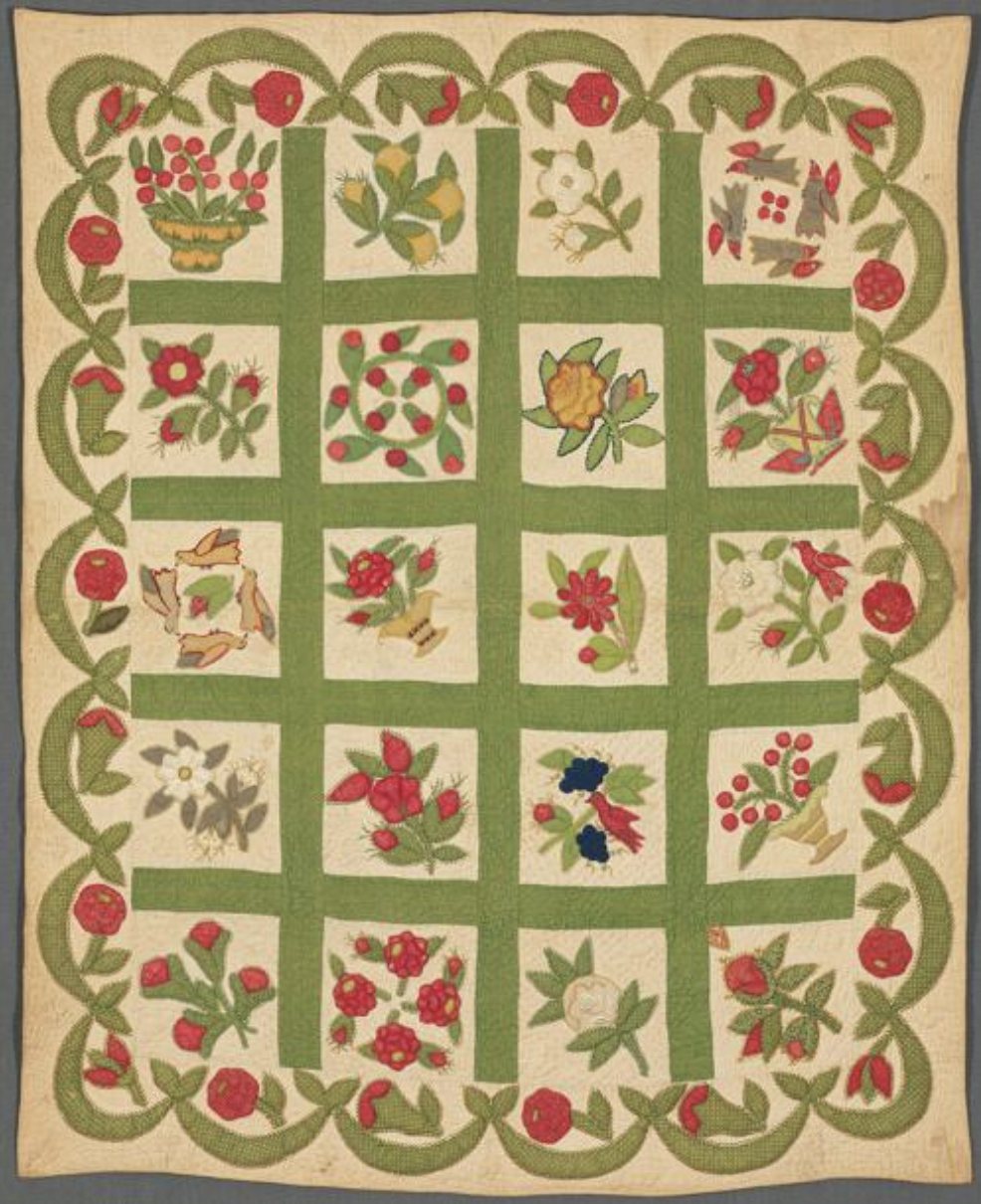
The increased availability of less costly fabrics during the early 19th century expanded the appliqué quilt tradition beyond the upper classes, who were the only ones who could previously afford the expensive fabric associated with this type of textile. The popularity of appliquéd quilts started around the 1840s and continued over the next few decades. Although appliquéd quilts often used repeated patterns laid out on a grid pattern, appliqué offered the maker the freedom and ability to create narrative and pictorial images, not easily achieved in pieced quilts often made from remnants of saved fabric. Art Institute Chicago
This collection documents an exceptional genre of the appliqué album quilt that proliferated in Baltimore in the 1840s and 1850s. The Baltimore style was developed by talented professional or semi-professional quiltmakers who designed the intricate blocks by which the style is most known, as well as women who created quilts, often collaboratively, within the settings of their family, social, and religious lives. The contributions of these quiltmakers can sometimes still be traced through extant signatures, dates, and inscriptions, marked in ink and embroidery thread. The rich iconography of the Baltimore style included botanical, political, maritime and civic symbols as well as emblems of the Odd Fellows and Masons, fraternal orders that flourished in Baltimore at the time. This collection covers a wide range of quilts in an understanding that the associations of time, place, techniques, materials, and iconographies gave rise to diverse aesthetic expressions unified in their identification with the Baltimore style. Quilts originating beyond the borders of city are included to connect these quilts to the broader quiltmaking activity of the region.
Technical Credits - CollectionBuilder
This digital collection is built with CollectionBuilder, an open source framework for creating digital collection and exhibit websites that is developed by faculty librarians at the University of Idaho Library following the Lib-Static methodology.
The site started from the CollectionBuilder-GH template which utilizes the static website generator Jekyll and GitHub Pages to build and host digital collections and exhibits.